
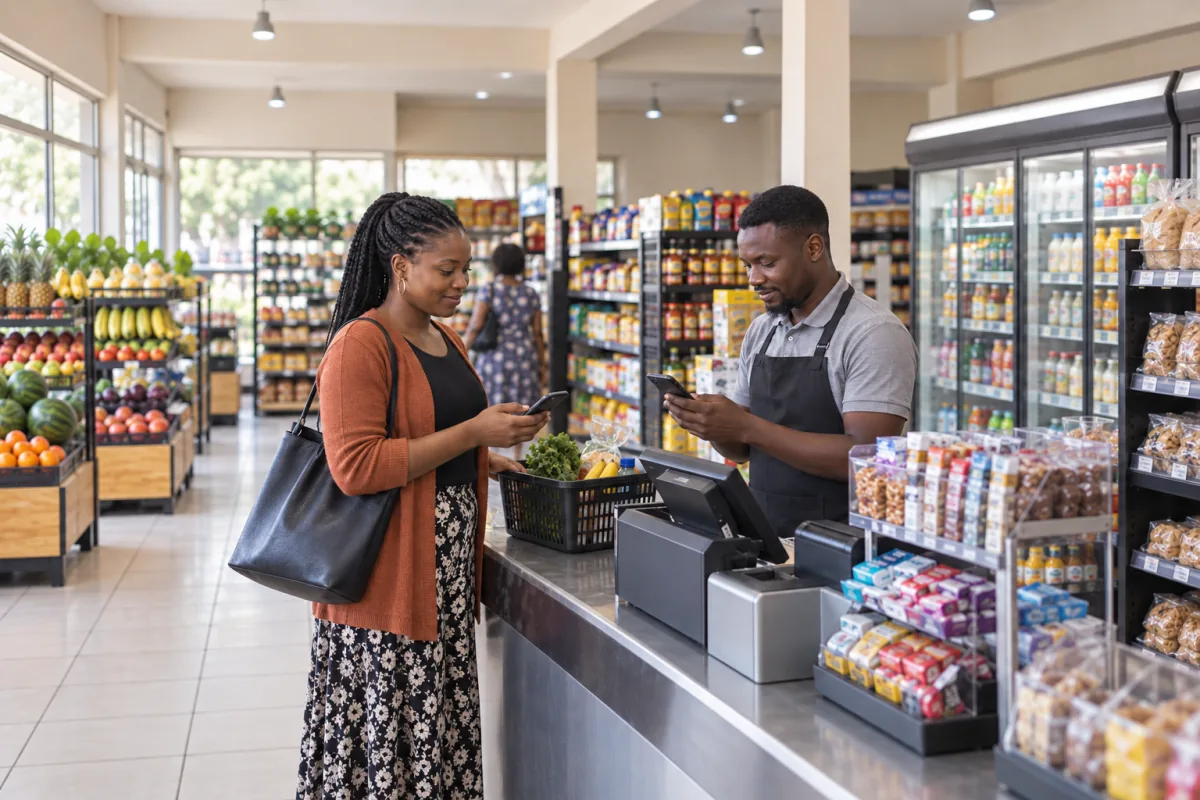
A customer can trust mobile money enough to receive their income through it and still prefer cash when buying lunch. A shopkeeper can use a wallet every day and still hesitate when a customer asks to pay into it. Neither decision is necessarily a contradiction.
Consider an ordinary purchase. The buyer wants to pay the agreed price and leave with the goods. The seller wants to know that the money has arrived and that it will be available for the next business expense. If digital payment introduces uncertainty into either side of that exchange, having a wallet is only the beginning.
This is an illustrative situation, but the underlying tension is well documented. GSMA’s January 2026 research describes merchant payment adoption as uneven, with continuing barriers around affordability, usability, trust, and infrastructure [1].
Our first article on mobile money at scale looked at the work around a payment: matching records, understanding settlement, and resolving differences. This article starts at the counter, where a customer and merchant decide whether to use digital money at all.
Our view is that lasting adoption depends on both parties having a practical reason to choose it again. That means understanding the purchase, the uncertainty around it, and what the merchant needs to do with the proceeds.
Growth is real. Everyday use is a different measure.
It would be misleading to describe merchant payments as a market where nothing is working. GSMA reports US$155 billion in global mobile money merchant payments in 2025, up 42% from the previous year [2]. Its wider account figures also show why scale and habitual use need separate attention.
| Global mobile money indicator, 2025 | Reported figure | What it measures |
|---|---|---|
| Registered accounts | 2.3 billion | Account registrations, not unique people |
| Active accounts over 30 days | 593 million | Accounts used within the reporting window |
| 30-day activity rate | 25.7% | Active accounts as a share of registered accounts |
| Merchant payment value | US$155 billion | Value processed in the merchant payment category |
Source: [2, pp. 9, 14–15]. Figures are global; account totals are rounded.
The activity rate does not establish that the remaining accounts are permanently dormant, or explain why they were unused. It also cannot tell us how often an active account paid a merchant. Those are different questions.
For a population-level perspective, the World Bank reports that 40% of adults in Sub-Saharan Africa owned a mobile money account in 2024, compared with 27% in 2021. That is substantial progress, while also making clear that mobile money ownership is far from universal. Access remains unfinished work [3].
Merchant use varies sharply between countries. Drawing on Global Findex 2025, GSMA reports that approximately 56% of adults in Kenya made a digital merchant payment, compared with 12% in Uganda and 9% in Côte d’Ivoire. These 2024 survey figures concern at least one in-person digital merchant payment in the preceding year. They measure participation, not the share of purchases paid digitally [1, p. 6].
A continent-wide account total cannot explain those differences. A useful investigation starts with a particular kind of merchant, the customers they serve, and the payment choices already available to them.
Zambia shows why the distinction matters
Zambia offers a useful example of both progress and the questions that remain. The Bank of Zambia’s Annual Report 2025 records a sharp acceleration in mobile money activity and identifies increased merchant acceptance, alongside wider use of person-to-person transfers, as contributing factors [4].
| Zambia mobile money indicator | Growth in 2024 | Growth in 2025 |
|---|---|---|
| Transaction value | 7.6% | 83.4% |
| Transaction volume | 33.4% | 65.5% |
Source: [4, Table 11.1, p. 84].
These are annual growth rates across the mobile money channel. Value measures money transferred; volume counts transactions. Neither establishes the share of shop purchases paid digitally. The Bank’s discussion nevertheless makes clear that merchant acceptance is already contributing to Zambia’s payment activity [4].
For a team building in this market, our interpretation is that the useful question becomes more specific: which purchases still create avoidable effort, and for whom? A growing national total can coexist with a customer struggling to confirm one payment or a merchant finding the proceeds inconvenient to use. Understanding those cases requires evidence from the particular businesses involved.
Cash sets a demanding benchmark
When people already have cash available, handing it over can be a remarkably simple way to finish a purchase. Neither party needs a charged phone or a connection. Where the correct change is available, the exchange can be quick and easy to understand.
Cash also brings costs: counting, storage, theft exposure, mistakes, and the work of depositing or transporting it. A fair comparison must include those costs alongside the visible charges and practical requirements of digital payment. CGAP’s merchant payments research sets out this comparison across convenience, speed, security, and cost [5].
The lesson we draw is to judge a payment method in the circumstances of the purchase. Cash may be inconvenient for a remote order and perfectly adequate for an inexpensive item bought in person. A digital receipt may be valuable to a business customer and less persuasive to someone making a purchase they do not need to document.
This changes the product question. What specific advantage will make this buyer and this seller willing to change a familiar routine?
There may be several good answers: fewer trips to deposit takings, easier payment before delivery, clearer business records, or simpler supplier payments. But the benefit needs to survive contact with the merchant’s working day. A feature that looks useful in a demonstration may have little value if it adds another task during the busiest hour.
A merchant accepts the next expense along with the sale
For a seller, receiving money is part of a continuing cycle. Stock has to be replaced. Transport has to be paid for. Some proceeds may support the household. The usefulness of a payment depends partly on whether it can fund those next obligations.
CGAP’s September 2025 analysis describes how cash-out and onward-transfer costs can add to the cost of digital acceptance when suppliers require cash or a person-to-person transfer. It also highlights a less obvious issue: in some small businesses, the person serving customers cannot access the owner’s payment confirmations [6].
Both observations point to the same design discipline: follow the people who actually handle the sale and follow the money after receipt.
Imagine two merchants receiving the same digital payment. One can immediately pay a supplier from the account. The other must withdraw the proceeds before restocking. The amount received is identical, but the effort required to make it useful is different. This is an illustrative comparison, not a claim about how frequently either situation occurs.
Withdrawal also depends on the agent having physical cash. An agent’s electronic balance and cash on hand serve different purposes; plenty of electronic value cannot, by itself, satisfy a cash withdrawal. CGAP’s research documents how liquidity shortages and the work of rebalancing those holdings can interrupt service [7].
That older research explains the mechanism; it does not establish today’s failure rates. More recent CGAP work argues that cash-in and cash-out networks remain important for low-income customers, including as digital finance expands [8].
Our inference is straightforward: dependable access to cash can support confidence in digital money during a transition. A merchant who knows they can meet a cash obligation has more room to accept a digital sale. Making funds useful beyond the first receipt deserves as much attention as making that receipt possible.
A small fee can take a large share of the margin
A payment fee is usually expressed as a percentage of the sale. A merchant has to absorb it from what remains after paying for the goods and other expenses. Those are very different denominators.
Consider a simplified example in arbitrary currency units. A merchant sells an item for 100 after buying it for 90. The gross profit before payment costs and other operating expenses is 10.
| Illustrative payment cost | Amount deducted from a sale of 100 | Gross profit remaining after payment cost |
|---|---|---|
| 0% | 0 | 10 |
| 1% | 1 | 9 |
| 2% | 2 | 8 |
Source: Author’s arithmetic, not a provider tariff or an estimate of typical merchant margins. Rent, wages, taxes, cash-handling costs, and other operating expenses are excluded.
In this example, a 1% payment charge consumes 10% of the initial gross profit. At 2%, it consumes 20%. Neither number proves that accepting digital payments is a bad decision. Additional sales or lower operating costs might more than compensate. It shows why describing a fee as small tells us little about whether the merchant can afford it.
The full comparison should follow the payment through its next use. Who pays to transfer it onward? Is a withdrawal necessary? Does accessing it take the owner away from the shop? Does digital acceptance remove a cost the business already bears?
Taxes need equally careful treatment. Ghana’s experience is more complicated than a simple claim that a levy permanently drove users back to cash. A 2024 ICTD working paper, using telecommunications data and nationally representative surveys, found a short-term fall in mobile money usage alongside a positive longer-term effect, particularly for payments to formal merchants. It also found gaps in users’ understanding of the levy’s design [9].
Ghana subsequently repealed the levy in April 2025 [10].
For us, the practical implication is to examine the actual charge, affected transaction, exemptions, and period before drawing a conclusion. A transfer tax, a merchant acceptance fee, and a withdrawal charge can influence different choices. Lumping them together obscures the behavior a product team needs to understand.
The difficult moment is when neither side knows what happened
Imagine the customer has submitted a payment, but the merchant cannot yet confirm receipt. The customer sees a debit and believes they have paid. The seller sees no dependable confirmation and hesitates to hand over the goods. Someone suggests trying again.
This hypothetical moment exposes an important requirement: both people need an understandable account of the same transaction. A fast interface alone cannot provide that.
GSMA’s merchant research identifies delayed confirmations, unreliable networks, complicated interfaces, and weak complaint handling as barriers to use [1, pp. 8–9].
Zambia also provides a concrete reminder that the payment experience depends on basic service continuity. The Bank of Zambia reports that K80 million from interest earned on mobile money trust accounts was directed toward maintaining network availability amid widespread power shortages in 2025 [4, p. 88]. For us, that reinforces the importance of evaluating a payment service under the conditions in which people actually use it.
Our interpretation is that payment certainty has two parts. During a normal purchase, the buyer and seller need to know when they can proceed. During an exception, they need to know what action is safe and who will resolve the problem.
A status such as “pending” may be technically accurate while leaving both people unsure whether to wait, pay again, or cancel the sale. Useful communication must connect the status to an action. The support experience then has to honor that explanation.
This is also why we would evaluate a payment flow with the person actually serving customers. If a shop assistant has to telephone the owner to confirm each receipt, the buyer experiences that delay as part of paying. Testing only the owner’s phone misses the transaction as it happens at the counter.
Interface choices deserve the same practical scrutiny. A team should test on the devices people already use, with the language, connectivity, and assistance available to them. Requiring a new device or a more complex routine introduces another decision before the customer can even consider the payment’s benefits.
We would measure the time until both parties can confidently finish the sale, including retries and requests for help. Measuring only how quickly a customer submits an instruction leaves out the part of the experience that can determine whether they return to cash.
Interoperability has to work in the purchase itself
Interoperability allows money to move between participating services. For a customer, its value is much more concrete: can the account they already use pay the merchant in front of them, at an acceptable cost?
There is substantial existing work to build on. GSMA has documented different technical models for mobile money interoperability and the commercial and liquidity tradeoffs associated with them [11].
AfricaNenda’s State of Inclusive Instant Payment Systems in Africa 2025 reports 36 live instant payment systems as of June 2025, up from 31 a year earlier. These are systems, not a count of merchants accepting every payment instrument. The report distinguishes the existence of infrastructure from its progress toward inclusion [12].
Our inference is that an infrastructure connection should be the start of an acceptance assessment. The next questions belong to the purchase: which providers and merchant types can participate, what the customer must enter, what each side pays, and how a problem travels across organizational boundaries.
A useful test would follow a real purchase between different providers from initiation through confirmation and access to the proceeds. A successful transfer between two test accounts answers a narrower question.
This is one reason there is no single African rollout formula. Existing services, participating institutions, and merchant needs have to be understood locally. A strong national payment system may create opportunities that require better distribution or clearer merchant value; another setting may still need more basic access and connectivity work.
A reason to keep using it
For a merchant, the strongest case for digital payment may extend beyond the transaction. CGAP’s work on merchant value examines services around customer relationships, inventory, finance, and business information. The important point is the connection to a business need [13].
Our test would be whether a proposed benefit removes work or improves a decision the merchant already cares about. Records that make the day’s takings easier to understand have a clear purpose. A dashboard that requires extra data entry needs a much stronger justification.
The provider’s economics matter too. CGAP’s January 2026 analysis examines the difficulty of funding reliable infrastructure, support, and distribution while serving merchants whose payments generate limited revenue. Low prices alone do not solve that problem [14].
We think the evidence for a durable service should include repeat use after an introductory incentive ends, the merchant’s total cost of accepting and using the funds, and the effort needed to resolve a failed purchase. It should also include the cost of providing dependable service. Growth that depends on an unsustainable level of support or subsidy leaves an important question unanswered.
These are proposed evaluation criteria, not results from research or pilots we have completed. They would help distinguish a product people are willing to try from one they find worth keeping.
Earning the next purchase
At Hashcode Fibration, the question that interests us is whether software makes a business’s daily work more dependable. In payments, that means taking the merchant’s ability to use the money and the customer’s confidence in the purchase seriously from the outset.
The counter brings those requirements together. The buyer needs a clear price and a dependable way to finish paying. The seller needs confirmation they can act on and proceeds they can use. Both need a workable path when something goes wrong.
Mobile money’s growth gives the industry a substantial foundation. Earning everyday purchases requires attention to the small decisions that turn access into a habit: whether the payment is worth the effort, whether the money will be useful, and whether both people can get on with their day.
That is the standard we think the next generation of merchant payment services should be built to meet.
If you work with merchants or payment operations, we welcome a conversation about the decisions you encounter at the counter.
References
[1] I. Carboni, “What Will It Take to Scale Merchant Payments? Harnessing the Digital Opportunity,” GSMA, Jan. 2026. [Online]. Accessed: Sep. 13, 2026.
[2] GSMA, “The State of the Industry Report on Mobile Money 2026,” 2026. [Online]. Accessed: Sep. 13, 2026.
[3] A. Norris and D. Singer, “Digital technology is unlocking financial inclusion,” World Bank, Jul. 17, 2025. [Online]. Accessed: Sep. 13, 2026.
[4] Bank of Zambia, “Annual Report 2025,” Lusaka, Zambia, Jun. 2026, sec. 11.1, pp. 84–88. [Online]. Accessed: Sep. 14, 2026.
[5] CGAP, “Cash Is King in Merchant Payments,” Oct. 2019. [Online]. Accessed: Sep. 13, 2026.
[6] R. Pillai, N. Baatjies, and X. Faz, “Why Merchants Still Choose Cash in Sub-Saharan Africa,” CGAP, Sep. 26, 2025. [Online]. Accessed: Sep. 13, 2026.
[7] K. McKee, M. Kaffenberger, and J. M. Zimmerman, “Doing Digital Finance Right: The Case for Stronger Mitigation of Customer Risks,” CGAP, Focus Note no. 103, Jun. 2015. [Online]. Accessed: Sep. 13, 2026.
[8] C. Martinez and E. Hernandez, “Cash vs. Digital? Unleashing the Power of DFS through Agent Networks,” CGAP, Dec. 5, 2023. [Online]. Accessed: Sep. 13, 2026.
[9] M. Carreras, A. Diouf, and H. Niesten, “The Ghana E-Levy: Impact on the Usage of Mobile Money,” Institute of Development Studies, ICTD Working Paper 201, Jul. 2024, doi: 10.19088/ICTD.2024.059. [Online]. Accessed: Sep. 13, 2026.
[10] Presidency of the Republic of Ghana, “Promises fulfilled: E-levy and other taxes officially scrapped,” Apr. 2, 2025. [Online]. Accessed: Sep. 13, 2026.
[11] A. Nautiyal, “Mobile money interoperability: One goal, many paths,” GSMA, Jun. 12, 2020. [Online]. Accessed: Sep. 13, 2026.
[12] AfricaNenda Foundation, “The State of Inclusive Instant Payment Systems in Africa 2025,” Nov. 2025, pp. 62–63. [Online]. Accessed: Sep. 14, 2026.
[13] CGAP, “Merchant Payments: Adding Value for Merchants,” Oct. 2019. [Online]. Accessed: Sep. 13, 2026.
[14] R. Pillai, N. Baatjies, and X. Faz, “How Providers Can Serve Micro-Merchants Sustainably,” CGAP, Jan. 27, 2026. [Online]. Accessed: Sep. 13, 2026.